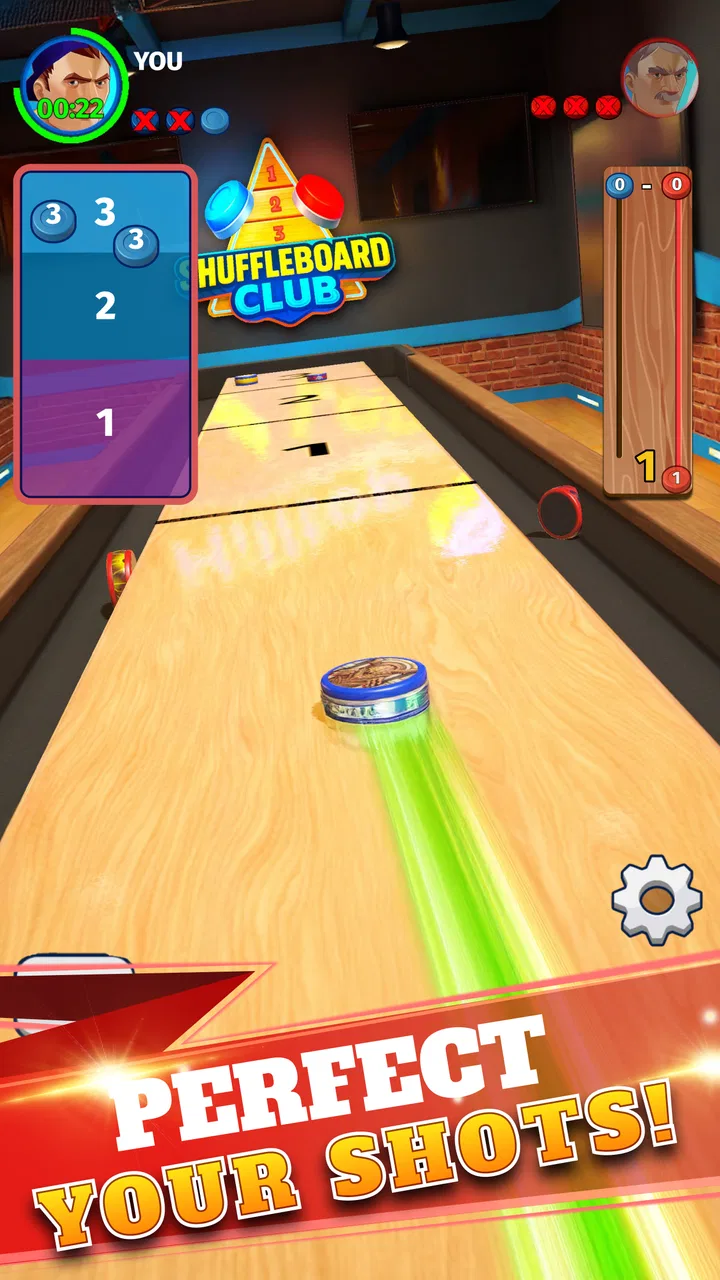
Shuffleboard Club: PvP Arena
- 4.6
- Rating
- 500.00K
- Installs
- Free
- Price
 Analysis by App-foxy
I went into Shuffleboard Club: PvP Arena expecting a simple sports game, and that is exactly where its appeal begins. The idea is easy to understand: slide a puck, judge the distance, try to score, and beat the other player on the board. There is no long tutorial to memorize and no complicated control scheme standing between you and the first match. For a quick game on a phone, that directness matters.
Developed by BoomBit Games, this free sports title focuses on player-versus-player shuffleboard matches. Its store summary points toward playing with friends, but the broader appeal is the same whether I am competing against someone I know or simply looking for a short competitive distraction. The game is rated for Everyone, so it is approachable for younger players as well as adults who want something calmer than a racing or action game.
What makes it worth discussing is not the basic rule itself, but the rhythm around it. I make a shot, immediately see whether my judgment was good, receive the result, and then get a reason to try again. That cycle is compact enough for a spare minute, yet it still creates the familiar tension of a close sports match. The best part is how one small slide can change the entire mood of a round.
You May Also Like

 Blood Strike: 2.5 Anniversary
Blood Strike’s Loadouts Turn Every Drop Into a Tactical Gamble
A close look at Blood Strike’s custom loadouts: how fast access to signature weapons reshapes its battle royale rhythm, rewards preparation, and narrows the gap between fights.

 Pandora - Music & Podcasts
Pandora’s Music Is Easy to Start, but Harder to Recover
Pandora’s strength is its low-effort path from a seed to a station. Its weak spot is how much confidence it asks you to place in connection, setup, and quiet recovery.

 8 Ball Pool
 Is Built on Rivalries, Rematches, and Routine
A close look at the rivalries, rematches, shared routines, and unanswered safety questions that turn a quick pool match into a persistent mobile community.

 Samsung Music
’s Quiet Strength Is Playing What You Already Own
Its reach comes less from spectacle than from dependable access to a personal library. That simplicity is both the app’s strongest retention engine and its ceiling.

 AccuWeather: Weather Radar
AccuWeather Review: A Quick, Clear Forecast for Everyday Decisions
For everyday plans, the best forecast is the one you can understand quickly. AccuWeather makes rain timing, radar, and local conditions easy to act on, with a few trade-offs.

 Hill Climb Racing
Why Hill Climb Racing Still Turns Crashes Into One More Run
A tiny car, a bumpy hill and one more upgrade: Hill Climb Racing keeps resurfacing because its simple chaos makes every near-miss feel personal.
More From Our News Desk



Why the first shot is more important than it looks
The first action in a shuffleboard match is wonderfully understandable. I do not need to learn a collection of buttons or remember a complicated move list. I focus on the board, line up the puck, and send it forward. That simplicity makes the game immediately usable when I am waiting for a friend, taking a break, or introducing it to someone who does not usually play mobile games.
At the same time, a simple control does not mean every shot is automatic. The challenge comes from judging how much force and direction to use. A cautious slide may leave a puck short of a valuable area, while an aggressive attempt can carry it too far. That creates a useful decision before every move: do I play safely, chase a better score, or try to disturb the opponent’s position?
I like this because the game does not bury the sports idea under unnecessary decoration. The board is the problem to solve, and the puck is the answer I have to shape. Even when I make a poor attempt, I generally understand why it failed. That clarity is important in a casual game; frustration feels fairer when the result follows from my own timing and judgment.
A good way to approach the opening shot is to treat it as information rather than an immediate attempt to win. I watch how far the puck travels and use that result to adjust the next move. This is one of the more useful habits I found: instead of repeating the same force, I make a small correction. The game becomes less about random swiping and more about reading the board.
That approach also helps when playing with a friend. A first move can reveal whether the match will be defensive, aggressive, or decided by tiny differences in placement. If one player puts a puck in a strong position, the other has to decide whether to build a score or interfere with it. The most interesting turns are not always the biggest ones; often, a modest placement creates the harder question.
Learning the board without turning it into homework
New players should resist trying to master everything immediately. I found it more useful to play a few turns while concentrating on one variable at a time. First, learn how the slide responds. Then pay attention to where scoring positions begin and end. After that, start considering the opponent’s puck. This gradual method keeps the game welcoming while still leaving room for improvement.
There is also a practical reason to avoid overthinking every move. Shuffleboard works because the action is quick. If I spend too long treating each turn like a tournament calculation, I lose the relaxed quality that makes a mobile sports game convenient. My preferred balance is to make a clear plan, take the shot, and accept the result quickly.
For families, that learning curve is a strong point. The basic interaction can be explained in a sentence, but better results come from practice. That gives experienced players an advantage without making beginners feel locked out. It is suitable for casual competition, especially when the goal is to share a few rounds rather than commit to a long gaming session.
Feedback that keeps each turn moving
The core feedback rhythm is the reason I kept starting another match. A shot leaves my control, travels across the board, and settles into a position that immediately tells me whether the decision worked. The movement provides anticipation, the landing provides a clear result, and the scoring response gives the turn a conclusion. Then the board becomes a new puzzle.
This sequence is more satisfying than a game that simply announces a result without showing the path to it. Here, the path matters. I can remember a shot that nearly reached a scoring area, a puck that went farther than expected, or a move that changed the balance between both players. Those small moments give the match a sense of continuity.
The feedback is especially useful for improving consistency. If my shots repeatedly fall short, I know I need to add force. If they overshoot, I can reduce it. If the direction is wrong, I can adjust the angle. The game does not need a long explanation after every turn because the board itself communicates the lesson.
That said, the same immediacy can expose the game’s limits. Players who want deep simulation, detailed physics tuning, or a large collection of sports systems may find the experience too focused. This is not trying to be a full recreation of every aspect of shuffleboard. Its satisfaction comes from the small loop of aiming, sliding, observing, and correcting.
Compared with a typical arcade sports game, the pace is less frantic. There is no need to react to a constantly moving opponent or manage a crowded screen. Compared with a traditional board-game app, however, the direct control gives each move more personal responsibility. I am not merely choosing an option from a menu; I am physically shaping the attempt through the slide.
Small adjustments make a bigger difference than bold moves
One practical tip is to avoid changing both direction and force dramatically at the same time. When I make a large correction to everything, it becomes difficult to understand what actually improved the shot. A smaller adjustment gives me a better sense of how the board responds and helps build a repeatable style.
Another useful habit is to look at the opponent’s placement before deciding what a “good” shot means. A strong scoring position in isolation may not be the best choice if it leaves the other player an easy answer. Sometimes the better move is the one that makes the next turn awkward. This is where the game becomes more strategic than its one-action control initially suggests.
I also recommend treating the final part of a match differently from the opening. Early turns are useful for learning the pace and establishing position. Later turns deserve more restraint because the value of a safe placement changes when the score is close. A player who always chases the most ambitious slide may give away a match that could have been secured with a controlled attempt.
What counts as a reward here
The reward in this game is mostly competitive rather than decorative. Winning a close exchange, placing a puck more accurately than before, or recovering from a weak opening gives the immediate satisfaction. I do not need a complicated progression system to understand why another match sounds appealing. The reward is the feeling that my next decision can be better.
That makes the game a good fit for players who enjoy short skill loops. I can play without preparing for a long campaign, and I can stop after a match without feeling that I have abandoned a major storyline. The compact structure respects the way people often use mobile games: in small gaps during the day, with attention available for only a few minutes at a time.
There is also a social reward when the game is used with friends. Shuffleboard is naturally easy to discuss while playing. A lucky-looking shot, a risky attempt, or a late comeback creates conversation without requiring both players to learn a complicated ruleset. This makes it more suitable for relaxed competition than games that depend on intense concentration or a large time commitment.
The free price lowers the barrier to trying it, although in-app purchases range from $0.99 to $99.99 per item. That is worth keeping in mind before handing the game to a child or allowing purchases on a shared device. The game’s basic invitation is easy to accept, but the presence of optional spending means I would still check the device’s purchase controls in a family setting.
Its audience numbers suggest that the game has already attracted a meaningful group of players: it has passed 100 thousand installs and holds an average rating of 4.6 from around 13 thousand ratings. Those figures do not replace personal experience, but they do indicate that the straightforward competitive format has found an audience. I can see why: the game explains itself through play rather than demanding a large initial investment.
Who gets the most from the reward loop
I would recommend it to someone who likes casual competition, simple sports controls, and matches that can be understood almost immediately. It is particularly suitable for friends who want a light contest rather than a serious multiplayer commitment. It can also work for players who enjoy improving through repetition, because small changes in force and placement are easy to test from one turn to the next.
I would be more cautious recommending it to a player looking for a broad sports package. If you want teams, seasons, career management, many different disciplines, or a large tactical system, this focused shuffleboard format may feel narrow. A conventional sports franchise or a deeper board-game adaptation would be a better choice for that kind of long-term variety.
It is also not the ideal pick for someone who dislikes competitive uncertainty. A carefully planned shot can still produce an outcome that feels less precise than expected, and close matches naturally include swings in momentum. The appeal comes from responding to those moments, not from having every result feel perfectly controlled.
The reset that makes another session tempting
One of the strongest design choices is how naturally a match leads to the next one. Once the result is clear, there is no heavy emotional commitment to recover from a loss. I can reset my approach, try a different opening, and see whether a small correction changes the outcome. The clean restart is a major reason this works better as a mobile game than a longer, more demanding sports experience.
A realistic everyday use case is a short break between tasks. I might have enough time for one match but not enough patience for a campaign mission or a ranked session that expects sustained attention. This game fits that gap because the objective is visible from the beginning, the action is turn-based, and the result arrives without requiring a large setup.
It also works well as a pass-and-play style activity when two people are sitting together, provided they are comfortable taking turns on the same device or arranging their match through the available multiplayer flow. The important point is that the game’s rules are easy to explain verbally. A friend can understand the goal by watching one shot, which removes much of the awkwardness that comes with introducing a more complex game.
The reset is not entirely frictionless for every player. Repetition is central to the design, so anyone who needs constant new content may feel that the same board interaction becomes familiar quickly. The game’s replay value depends on the quality of the competition and on the player’s desire to refine decisions. Without that interest, the simple loop may feel limited rather than elegant.
Version 1.5.6 is the current version, and the game supports devices running Android 7.0 or later. That makes it accessible to people using older Android hardware, although the experience will still depend on the particular phone’s performance and screen response. I appreciate that the minimum requirement does not push the game into the category of titles that demand a recent flagship device.
The release date is Dec 5, 2025, and the age rating is Everyone. Those details reinforce the game’s position as a broadly approachable sports title rather than an intense or mature competitive experience. I would still supervise spending for younger players, but the underlying activity is easy to share across age groups.
When resetting is better than forcing a comeback
A useful way to enjoy the game is to stop treating every match as a test of pride. If I make several poor shots in a row, I can use the reset as a learning tool instead of forcing increasingly risky moves. I note what went wrong, start again, and focus on one improvement. That keeps a bad round from turning into a frustrating spiral.
For a friend group, changing the goal between matches can also keep the loop fresh. One round can emphasize safe placement, another can focus on disrupting the opponent, and another can simply be played quickly. These variations do not require new modes or complicated rules; they come from choosing a different attitude toward the same board.
This is a subtle strength. The game does not need to overwhelm me with systems to create replay value. It gives me a small physical problem and lets the competition supply the variety. The trade-off is that the experience depends heavily on the people playing and on whether the basic act of sliding remains satisfying for them.
My verdict on the complete action-to-reset loop
Shuffleboard Club: PvP Arena succeeds because its central loop is easy to feel. I take a shot, watch the puck travel, read the result, and decide whether the next move should be safer or bolder. The reward is a better position, a close win, or simply the evidence that my judgment improved. When the match ends, the reset is quick enough to make another attempt feel natural rather than demanding.
That focus is both its strength and its boundary. I enjoy it most when I want a low-pressure sports game with a competitive edge. I would not choose it as a replacement for a full sports simulator, a deep strategy game, or a constantly changing arcade title. Its board is intentionally narrow, and the people who love it will be the ones who find depth in small decisions.
The game is free to start, rated Everyone, and available from BoomBit Games for Android users on version 7.0 or later. With over 100 thousand installs and a 4.6 average from around 13 thousand ratings, it has a clear place among casual sports games. The optional purchase range means families should manage spending settings, but the main appeal remains the quick match rather than a complicated economy.
My recommendation is simple: try it if you like the idea of a short, readable contest where control comes from judgment instead of frantic reactions. Invite a friend, play without overthinking the first round, and then use the next match to make one deliberate adjustment. If that action, feedback, reward, and reset rhythm feels satisfying to you, this is a small game with plenty of room for friendly rivalry.
FAQs for Shuffleboard Club: PvP Arena
01What is Shuffleboard Club: PvP Arena?
Shuffleboard Club: PvP Arena is a competitive multiplayer game that brings the classic tabletop shuffleboard experience to your mobile device. Players can engage in real-time PvP matches, challenge friends, and participate in tournaments. With intuitive controls and vibrant graphics, it offers an engaging and strategic gameplay experience.
02Is Shuffleboard Club: PvP Arena free to play?
Yes, Shuffleboard Club: PvP Arena is free to download and play. However, it includes optional in-app purchases that allow players to buy premium items, skins, or power-ups. These purchases can enhance gameplay but are not necessary to enjoy the full experience of the game.
03What are the device requirements for Shuffleboard Club: PvP Arena?
Shuffleboard Club: PvP Arena requires a device running Android 5.0 or iOS 10.0 and above. The game is optimized for both smartphones and tablets, providing a smooth experience across different screen sizes. Ensure you have a stable internet connection to enjoy seamless multiplayer matches.
04How can I improve my skills in Shuffleboard Club: PvP Arena?
Improving your skills in Shuffleboard Club: PvP Arena involves practicing regularly and mastering the game’s controls. Engaging in practice matches, observing top players, and learning different strategies can significantly enhance your gameplay. Additionally, participating in tournaments can provide valuable experience against skilled opponents.
05Can I play Shuffleboard Club: PvP Arena with friends?
Yes, you can play Shuffleboard Club: PvP Arena with friends by inviting them to join a match or challenging them in PvP battles. The game features a social component that allows you to connect with friends, track their progress, and compete in friendly matches to see who reigns supreme on the shuffleboard.
Pros
- Engaging real-time PvP matches.
- Smooth
- intuitive controls.
- Highly detailed graphics.
- Diverse arenas to unlock.
- Regular updates with new content.
Cons
- Requires stable internet connection.
- In-app purchases can be pricey.
- Occasional matchmaking delays.
- Limited offline gameplay options.
- Ads can interrupt gameplay.

Shuffleboard Club: PvP Arena
Gallery